Indexes: The Cheapest Performance Win You Keep Skipping
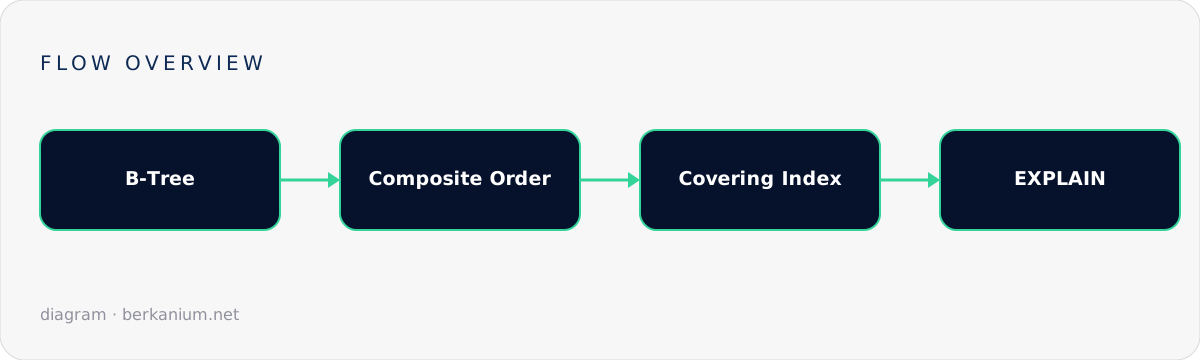
The B-tree mental model everything follows from, composite column order as the whole game, covering and partial indexes, reading EXPLAIN without a priesthood, and the quarterly maintenance contract.
Of all the performance work I get called in for, database indexing has the best ratio in the business: an hour of reading query plans, one CREATE INDEX, and a 40-second report becomes 80 milliseconds. It's also the area with the widest gap between "I know indexes make queries fast" and actually being able to design one — because the useful knowledge isn't the syntax, it's the mental model of what the database does with your WHERE clause. Let's build that model.
The B-tree, and the one property everything follows from
A B-tree index is a sorted structure: walk from the root a few hops and you land at your value, then read leaf entries in order. Every practical rule descends from that sortedness:
- Equality and ranges are cheap (
=,<,BETWEEN,LIKE 'abc%') — they're a seek plus a scan along the leaves. - Anything that defeats sortedness defeats the index:
LIKE '%abc'(sorted by prefix, not suffix),WHERE YEAR(created_at) = 2026(the index storescreated_at, notYEAR(created_at)— rewrite as a range, or in Postgres, index the expression), and implicit type casts (WHERE phone = 5551234against a varchar column casts every row — a genuinely classic outage). - ORDER BY can be free. If the index order matches the query's order, sorting costs nothing; if not, the database sorts in memory (or worse, on disk).
ORDER BY created_at DESC LIMIT 20on an indexed column reads exactly 20 leaf entries and stops.
Composite indexes: order is the whole game
The most consequential — and most-botched — decision. An index on (tenant_id, status, created_at) is sorted by tenant, then status within tenant, then date within that. Think of a phone book sorted by surname-then-firstname: instantly useful for "all Yılmaz", useless for "everyone named Berkan".
-- One index: (tenant_id, status, created_at)
WHERE tenant_id = 7 AND status = 'open' ORDER BY created_at DESC   -- ✅ perfect
WHERE tenant_id = 7                                                -- ✅ prefix works
WHERE status = 'open'                                              -- ❌ no leading column
WHERE tenant_id = 7 AND created_at > '2026-01-01'                  -- ⚠ uses (tenant_id),
                                                                   --   range-scans the rest
The design heuristic that serves in 90% of cases: equality columns first (most selective early), then the range or sort column last — because once the index hits a range, columns after it stop narrowing the search. And the corollary people miss: that composite already covers queries on tenant_id alone, so the separate single-column index next to it is dead weight — every index is a tax on writes and a candidate for deletion. (In multi-tenant schemas, "does every index lead with tenant_id?" is audit question number one.)
Covering indexes: skipping the second trip
A normal index lookup is two steps: find matching entries in the index, then fetch the full rows from the table. If the index contains every column the query needs, step two vanishes — the "index-only scan" that turns hot-path queries into pure index reads:
-- Postgres: INCLUDE carries payload columns without sorting by them
CREATE INDEX idx_orders_list ON orders (tenant_id, created_at DESC)
    INCLUDE (status, total_minor);

-- MySQL: put them at the composite's tail for the same effect
-- The list query now never touches the table at all:
SELECT status, total_minor FROM orders
WHERE tenant_id = 7 ORDER BY created_at DESC LIMIT 25;
Reserve this for genuinely hot queries — covering indexes are wide, and wide indexes cost memory and write throughput. Two other specialists worth knowing: partial indexes (Postgres: CREATE INDEX ... WHERE status = 'pending' — tiny index over the 2% of rows you actually query, brilliant for queue-ish tables) and expression indexes for the computed lookups mentioned above.
Reading EXPLAIN without a priesthood
You don't need to parse every field; you need to spot four things in EXPLAIN ANALYZE output:
- Seq Scan / type: ALL on a big table in a hot query — the headline finding. (On a 200-row table it's fine and faster than an index; don't "fix" those.)
- Rows estimated vs rows actual wildly diverging — the planner's statistics are stale (
ANALYZEthe table) and every downstream choice is built on fiction. - Sort nodes (Using filesort in MySQL) on user-facing paths — a missing ORDER BY-compatible index.
- Nested loops over large row counts — often the ORM's fault, not the planner's.
And where do candidate queries come from? Not from guessing: Postgres's pg_stat_statements or MySQL's slow query log, sorted by total time (a 50ms query running 10,000×/hour beats the scary 4-second nightly report). That sorted list plus this post is the whole methodology.
The maintenance contract
Indexes are living infrastructure: check usage stats quarterly (pg_stat_user_indexes — unused indexes are pure write-tax; I routinely delete a third of what I find), add new ones CONCURRENTLY in production, and re-verify plans after major version upgrades — planners change their minds. The steady state to aim for: every hot query has a purpose-built path, every index has a query that justifies it, and EXPLAIN holds no surprises. Boring, fast, and cheaper than any hardware you were about to buy.
Slow query log burning a hole in your dashboard? An indexing audit is the single highest-ROI engagement I offer — bring the top ten, leave with the fixes.