Job Queues Done Right: Retries, Dead Letters and Idempotent Everything
Payloads as IDs and intent, the 0-1-3 execution assumption, retry policies you design instead of inherit, lanes by latency class, and the four dashboard numbers that catch every queue pathology.
Job queues are where web applications hide their true complexity. The request/response layer is a well-lit showroom; the queue is the warehouse out back where emails, exports, webhooks, image processing and that one nightly reconciliation actually happen — and where failures go unnoticed until a customer asks why their invoice never arrived. After building and un-breaking a lot of these (Laravel/Redis, Hangfire, RabbitMQ consumers), here's the design playbook that separates a queue from a job graveyard.
Rule 1: jobs are messages, not closures with feelings
A job's payload should be IDs and intent, never objects and state: SendInvoiceEmail(invoice_id: 4211), with the handler re-fetching current truth at execution time. Serializing the whole invoice into the payload bakes in a snapshot that's stale by the time the job runs — the queue-flavored version of the fat-event mistake from the events post. (Laravel's SerializesModels gets this right by storing keys and re-querying; know that it does, because the "job saw old data" mystery is usually someone passing arrays around it.) Corollary: a job that no longer makes sense at run time — invoice deleted, user gone — should discard itself quietly, not throw and retry into a wall.
Rule 2: assume every job runs 0, 1, or 3 times
At-least-once delivery plus retries means duplicates are policy, not accident. Every handler needs an idempotency answer, and "it's probably fine" isn't one:
public function handle(): void
{
    $invoice = Invoice::find($this->invoiceId);
    if (! $invoice || $invoice->email_sent_at) {
        return;                                    // natural idempotency guard
    }

    Mail::to($invoice->customer)->send(new InvoiceMail($invoice));

    // Claim the fact atomically — affected-rows is the truth
    Invoice::whereKey($invoice->id)
        ->whereNull('email_sent_at')
        ->update(['email_sent_at' => now()]);
}
For side effects on external systems (charges! legal documents!), pair the guard with idempotency keys passed to the provider. And the "0 times" case: jobs get lost — Redis restarts with weak persistence, deploys race enqueues. Critical flows deserve a reconciliation sweep ("invoices issued >1h ago with no email_sent_at → re-enqueue") — the outbox pattern's pragmatic cousin.
Rule 3: retries are a designed policy, not a default you inherited
public int $tries = 5;
public function backoff(): array { return [30, 120, 600, 3600]; }   // exp + spread
public function retryUntil(): DateTime { return now()->addHours(6); } // hard deadline

public function failed(Throwable $e): void
{
    // The job is now DEAD — this must be an event somebody sees.
    Log::error('invoice email permanently failed', ['invoice' => $this->invoiceId, 'e' => $e]);
    // + metric increment + alert routing
}
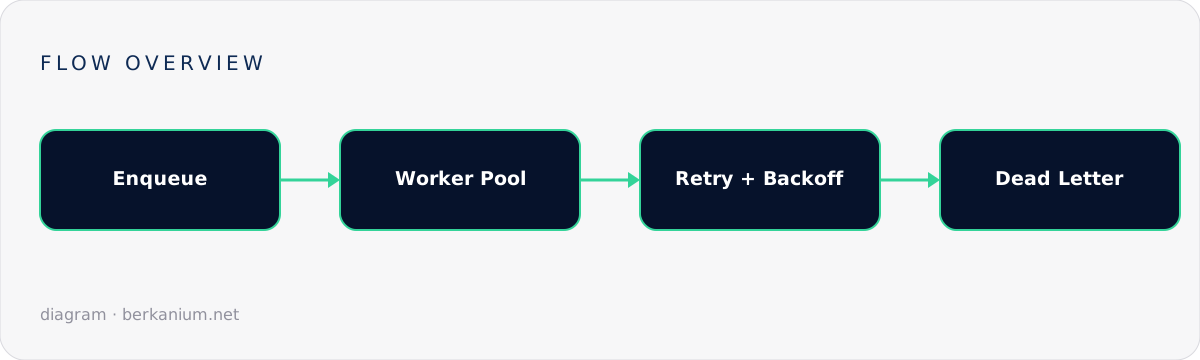
Decisions embedded there: exponential backoff (immediate retries against a down provider are a self-DDoS), a retryUntil so time-sensitive jobs die honestly instead of firing "your table is ready" at midnight, and — the big one — failed jobs as first-class events. Distinguish retryable errors (timeouts, 429s) from permanent ones (validation, 404s): permanent failures should skip the retry ladder entirely ($this->fail($e)) rather than waste five attempts discovering the same 422. The failed-jobs table is your dead-letter queue: it needs an owner, an alert on growth, and a weekly review ritual — a DLQ nobody reads is just a slower /dev/null.
Rule 4: queues are lanes, and lanes have speed limits
One default queue means the 20-minute export ahead of every password-reset email. Segment by latency class, not by feature: critical (user-facing, seconds matter — password resets, broadcasts), default, and heavy (exports, media, bulk syncs) — with worker pools sized per lane so heavy can saturate without touching critical. Two ops rules complete it: timeouts below the worker's kill threshold (a hung job should die informatively, not zombify the worker), and memory-bounded workers that restart themselves (--max-jobs, --max-time) because long-lived PHP/.NET workers accumulate state entropy no matter what anyone promises.
Rule 5: a queue without metrics is a rumor mill
Four numbers, per lane, on a real dashboard: depth (backlog), oldest-job age (the honest latency metric — depth 10,000 of fast jobs is fine; depth 12 with a 40-minute-old job is an incident), failure rate, and throughput vs. worker capacity (are we keeping up, structurally?). Horizon gives Laravel folks most of this out of the box; everyone else wires it into the metrics stack in an afternoon. Alert on oldest-job age and failed-count growth — those two catch every queue pathology I've ever debugged, usually before users do.
The checklist
□ Payloads = IDs + intent; handlers re-fetch truth, discard stale work
□ Every handler idempotent (guard column / unique claim / provider key)
□ Backoff + retryUntil designed; permanent errors fail fast
□ DLQ owned, alerted, reviewed — with a replay path
□ Lanes by latency class; workers sized & self-recycling per lane
□ Oldest-job age on a dashboard with a pager attached
Get these six right and the warehouse out back runs itself — which is precisely the point of having one. Choosing the broker underneath it all is its own decision; the RabbitMQ-vs-Kafka post handles that argument. And if your failed_jobs table currently has 40,000 rows and no owner — I know that archaeology well.