Rancher in Production: Taming a Kubernetes Fleet Without Hiring an Army
When cluster number two arrives, Rancher stops being a dashboard and starts being a hiring decision you skip: RBAC done once, Fleet GitOps, K3s at the edge, and the rules I learned the hard way.
Kubernetes has a funny property: the demo takes an afternoon, and the second cluster takes a quarter. One cluster is a pet you can hand-feed with kubectl. Then someone wants staging separated from prod, the client in Frankfurt needs their workloads in-country, an edge box appears in a factory — and suddenly you're running five clusters with five sets of users, certs, upgrades and 2 a.m. questions. That's the moment Rancher stops looking like "a dashboard" and starts looking like a hiring decision you don't have to make.
What Rancher actually is (and isn't)
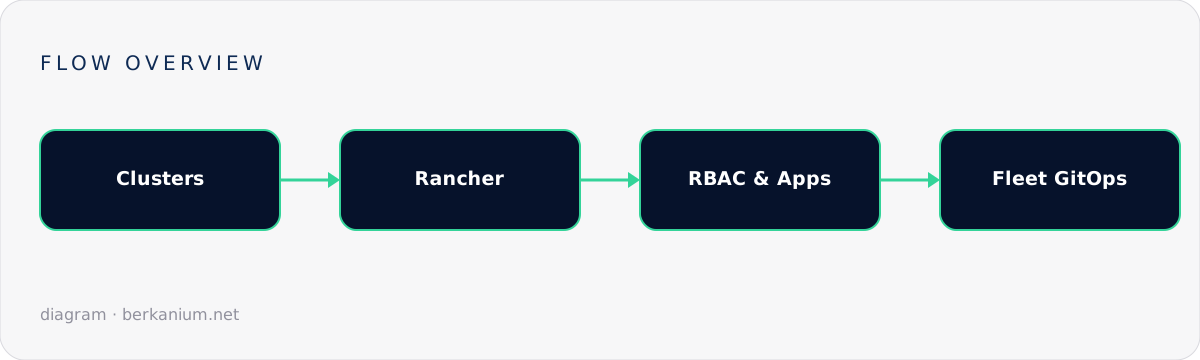
Rancher is a management plane that sits above your Kubernetes clusters. It doesn't replace Kubernetes; it imports or provisions clusters — RKE2/K3s on your own metal, EKS/AKS/GKE in the clouds — and gives you one place for the boring, critical stuff:
- One login, real RBAC. Wire it to your identity provider once; project-level permissions land on every cluster consistently. "Give the new backend dev access to staging namespaces only" becomes a click instead of a YAML archaeology session per cluster.
- Cluster lifecycle. Provisioning, node pools, Kubernetes version upgrades with sane defaults — the chores that otherwise live in a wiki page titled "DO NOT LOSE THIS".
- Fleet, the built-in GitOps engine. Point it at a repo, target clusters by label, and your deployments reconcile continuously across the whole herd.
What it isn't: an excuse to skip learning Kubernetes. Rancher amplifies operators; it doesn't replace understanding. The teams that hurt with it are the ones who clicked through the UI for a year and can't tell you what a PodDisruptionBudget is.
The shape of a sane setup
The pattern I keep converging on, whether the client has three clusters or thirty:
rancher-mgmt (small, boring HA cluster — runs ONLY Rancher)
├── prod-eu       (RKE2, on-prem or cloud)
├── prod-tr       (RKE2, data residency)
├── staging       (cheaper nodes, same versions as prod!)
└── edge-*        (K3s on factory/store hardware, imported)
Two hard-earned rules in that diagram. First: Rancher gets its own cluster. Running the management plane inside a workload cluster feels efficient right up until that cluster has a bad day and takes your ability to manage every other cluster down with it. Second: staging runs the same Kubernetes version as prod. Rancher makes upgrades easy enough that people upgrade staging, get busy, and let prod drift two minor versions behind. Then an upgrade jumps versions and the fun begins.
Fleet in five minutes
Fleet is Rancher's GitOps tool and it's underrated. You describe what goes where with cluster labels, and Fleet keeps reality matched to git:
# fleet.yaml — lives next to your chart/manifests in git
defaultNamespace: myapp

helm:
  releaseName: myapp
  valuesFiles:
    - values.yaml

targetCustomizations:
  - name: production
    clusterSelector:
      matchLabels:
        env: prod
    helm:
      valuesFiles:
        - values.yaml
        - values-prod.yaml     # more replicas, real resource limits

  - name: staging
    clusterSelector:
      matchLabels:
        env: staging
    helm:
      valuesFiles:
        - values.yaml
        - values-staging.yaml
New cluster joins with label env: prod? It gets the app, the prod values, automatically. Someone kubectl-edits a deployment by hand? Fleet quietly puts it back. The first time drift-correction reverts a hotfix someone applied outside git, you'll have an awkward retro — and then you'll never deploy outside git again, which was the point.
Things I wish someone had told me
- Back up Rancher's own state. The rancher-backup operator exists; schedule it before you need it. Losing the management cluster without a backup means re-importing everything and rebuilding RBAC from memory. Memory is bad at RBAC.
- Use projects, not just namespaces. Rancher's project abstraction (a group of namespaces with shared quotas and permissions) maps beautifully onto "team owns these apps". It's the difference between 40 RBAC bindings and 4.
- Don't expose the Rancher UI to the open internet. It's your master key. VPN or identity-aware proxy in front, always. (While you're at it, send its audit log somewhere — see the Graylog piece.)
- K3s at the edge is a gift. Single-binary Kubernetes on a shop-floor NUC, imported into the same Rancher, deployed by the same Fleet repo. Stores, factories, kiosks — suddenly they're just clusters with labels.
- Resist the app catalog buffet. One-click installs are great for trying things and terrible for owning them. If it's stateful and matters, install it deliberately with pinned charts in git.
When you don't need Rancher
Fairness demands this section. One managed cluster on EKS/AKS with a small team? The cloud console plus ArgoCD covers you; Rancher would be another thing to patch. Rancher earns its keep at plural — plural clusters, plural teams, plural environments. Below that threshold it's a beautiful hammer without a nail.
Somewhere between two clusters and chaos? That's exactly the phase I like helping teams through — book a session, or read on about the logging layer every fleet needs next.